Hiring like the best
Learnings from interviewing with OpenAI, Cursor, Vercel, etc.
I recently interviewed with OpenAI, Cursor, Vercel, and Midjourney (among others) and noticed all the things they do better than other companies. When I was a founder I certainly didn’t realize how big of a difference these things make for a candidate. None of these include having infinite money. Some of these sound obvious, like “moving fast”, but with concrete examples from these companies you’ll see that their “fast” is not the same as everyone else’s. Some might feel impossible without a brand like Cursor's or being famous like Guillermo. I don’t think that’s true. Let me explain why.
The best companies recruit on X
I posted a tweet that went viral about a better diff viewer. Overnight, I got messages from Cursor, OpenAI, Vercel, Cognition among others, but not a single startup tried to hire me. It's the same for everyone I know who's gone viral. The best companies hire talent from X; startups don't. Instead, they rely on external recruiters or their network.
When I ask founder friends about this, usually they just never thought about it or assumed they didn't have a chance. I think that's false. I answered every DM I got after my post, even from random accounts.
So why is hiring from viral posts a good idea? First, they pre-select for exactly what you want in a startup hire: agency, taste, and being able to communicate ideas. You can also see their code, product thinking, and execution before ever talking to them - removing much of the hiring risk. Second, competition is surprisingly low: usually just 1–5 other companies reach out. Third, once these candidates join, they bring awareness to your company and other candidates want to work with people they admire. Vercel set up a call for my friend with Shadcn just to convince him to join.
Contrast this with typical startup sourcing. Most founders work with external recruiters who use LinkedIn Recruiter. They all target the same people: SF, ex-Figma/Linear/Notion, "open to work," recent layoffs, etc. Everyone is competing for the same candidates with huge offers. And since most of these people have no public work, you need the full interview process to know if they're any good.
So sourcing from X gets you better candidates with less competition. But that only matters if you can close them.
Hire faster than everyone else
That a hiring process dragging on for weeks is bad seems obvious. Less obvious is that it's extremely important to be faster than every other company. Most people don't know how fast that actually is.
Here are some benchmarks:
- Vercel: Guillermo sent a Google Meet link one minute after I replied to his DM. 24 hours later, they sent an offer.
- Cursor: They don't normally do remote onsite interviews, but in two days they created a brand-new interview just for me.
- OpenAI: I spoke with the hiring manager on Thursday while he was in Hawaii for an offsite. By Friday, I had six interviews scheduled for Monday.
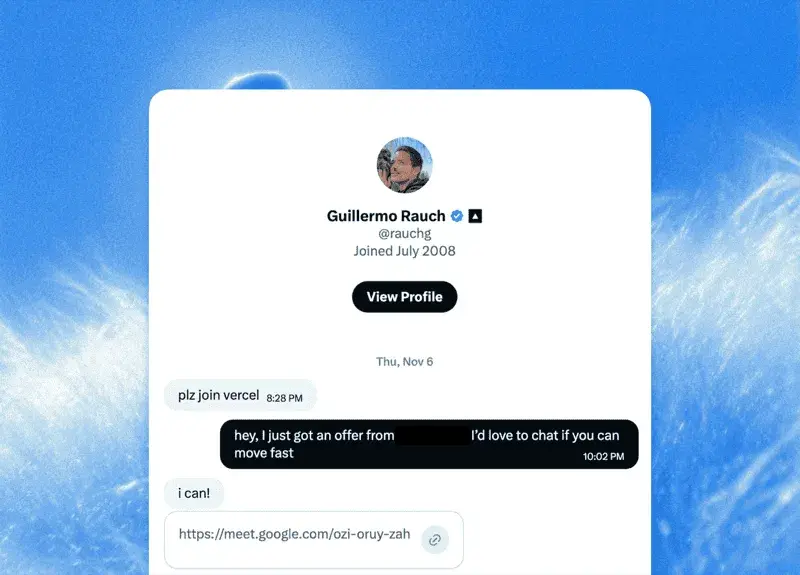
I got offers from all these companies within a week, the same time it took other companies just to schedule the next call. They did this by cutting interviews, compressing multiple interviews into one day, and taking calls late at night during weekends.
One of the first companies I interviewed with said they could move fast. I was very excited. The entire process ended up taking five weeks. If it had been a week, I very likely would have signed and they wouldn't have faced any competition. Instead, during those weeks, more companies reached out, I received several offers they simply couldn't compete with, and I realized my market value was way above what I expected.
What I underestimated as a founder is how painful interviewing is. You're in a stressful environment, getting semi-random challenges thrown at you. You don't know how long it will take, what different processes are like, or what your market value is. Then a company you really like shows conviction, makes a great offer, and seems genuinely excited to have you. You have to choose between uncertain odds of getting a better offer or a certain way out of the pain. Most people take the offer.
Being really fast will get you candidates you otherwise couldn't.
You don't need exploding offers to move fast
You don't even need exploding offers. After Cursor sent theirs, multiple people from the team reached out daily. They sent links to relevant posts, asked if there was anything they could do to help make the decision clearer, or if I had any concerns about the offer. It starts feeling weird to say "the offer is great but I just need to think" multiple times. You don't want to send the signal that you're not as excited as they are.
When I was choosing between OpenAI and Cursor, they put me on a call with someone who had left OpenAI for Cursor, and that person explained why they made the switch.
The hour after I signed, I got a video call from three future colleagues welcoming me to the team and text messages from almost everyone I'd spoken to during the process. It made me really excited to start.
This isn't accidental. At Cursor, they create a dedicated Slack channel for every person they want to hire. There, they brainstorm how to get that person to join. You really feel this while interviewing, while deciding, and right after you sign.
One nice side effect: once you've experienced this kind of treatment, you naturally want to give the same experience to the next person who joins. It builds a positive culture and makes everyone feel welcomed.
Project interviews
Some of the most frustrating interviews are those where you never get to show what you're uniquely good at. Companies try to create difficult challenges, but end up testing for specific knowledge - not very useful when Opus can implement most things. Startups should interview for agency, taste, and problem solving instead. That's why Cognition and Cursor do project interviews. There was a viral tweet about Cognition’s process, so I’ll focus on Cursor’s.
Cursor does a 2-day project followed by a presentation. The projects are deliberately open-ended so you can direct them toward your strengths. To figure out what to build, you do what you'd do on the job: talk to the team, research, and make decisions.
Here's how it works:
- You choose from 3 different projects or propose your own. Usually these are problems that are top of mind for the team.
- You're added to a Slack channel with ~20 people where you can ask questions.
- At the end, you present your work to a few team members and they ask questions.
This tests how well you navigate unfamiliar code, and by the time you start, you've already onboarded. Multiple people continued their project after joining. The trial is also filled with informal conversations: lunch with team members, walks with founders. Cursor knows that getting people to the office makes them significantly more excited to join.
The point is that hiring well isn't just about paying more. There are many levers that don't cost money and don't take much extra time, but dramatically improve your ability to land great people.